

Guest connectivity expectations have evolved beyond “free WiFi.” Here’s why leading hotels are upgrading to FTTR—and what it means for your property.
Traditional WiFi Isn't Meeting Guest Expectations Anymore
Walk into any hotel lobby across the region, and you’ll hear the same question: “What’s the WiFi password?” But today’s guests aren’t just checking email anymore. They’re streaming 4K content, attending video conferences from their rooms, gaming online, and running smart home devices—all simultaneously.
The average hotel guest now travels with 3-5 connected devices. Business travelers expect seamless video calls. Families want uninterrupted streaming across multiple rooms. Remote workers need reliable connectivity that rivals their home office setup.
Traditional WiFi infrastructure simply wasn’t designed for this level of demand. The result? Bandwidth bottlenecks during peak hours, dead zones in certain rooms, inconsistent speeds, and frustrated guests who remember poor connectivity long after they’ve checked out. In an era where connectivity directly impacts guest satisfaction scores and online reviews, hotels can’t afford to treat internet access as an afterthought.
Add to this the security vulnerabilities inherent in shared network environments, and many hospitality operators are realizing their WiFi infrastructure has become a liability rather than an amenity.
What is FTTR?
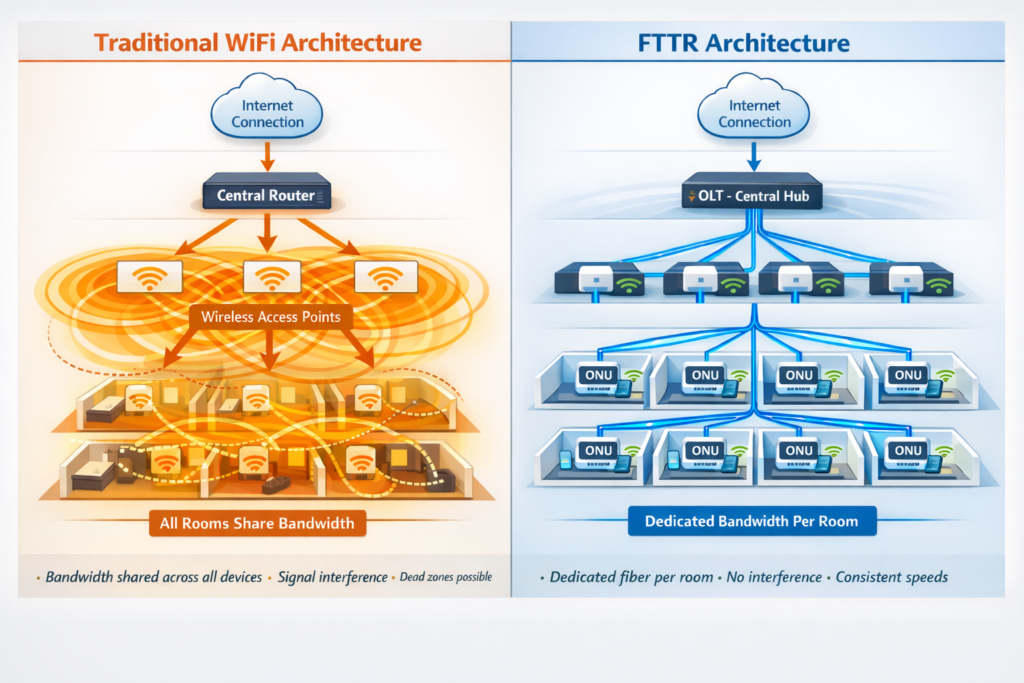
Fiber to the Room (FTTR) represents a fundamental shift in how hotels deliver connectivity to guests. Instead of relying on wireless access points distributing signal from a central location, FTTR runs dedicated fiber optic cables directly to an Optical Network Unit (ONU) installed in each guest room.
Think of traditional WiFi as a highway where all traffic shares the same lanes—congestion is inevitable during peak times. FTTR, by contrast, gives each room its own dedicated express lane with guaranteed bandwidth that doesn’t degrade based on how many other guests are online.
The architecture is elegantly simple: a main Optical Line Terminal (OLT) in your network room connects via fiber cables to individual ONUs in each room. Each ONU then provides WiFi coverage for that specific room, creating isolated, high-performance networks throughout your property.
This isn’t just faster WiFi—it’s a completely different infrastructure approach that eliminates the fundamental limitations of wireless distribution systems.
Why MENA Hospitality Is Making the Switch
Guaranteed Bandwidth Per Room
With traditional WiFi, bandwidth is shared across all connected devices. A guest streaming a movie in room 305 directly impacts the video call quality for the business traveler in room 307. FTTR eliminates this competition—each room receives dedicated bandwidth regardless of property-wide usage.
Unmatched Reliability
Fiber optic connections are immune to the radio frequency interference that plagues traditional WiFi. No more complaints about connectivity dropping when the microwave runs or when rooms are at capacity. FTTR delivers consistent performance 24/7.
Enhanced Security
Each room operates on an isolated network segment. A compromised device in one room cannot access another guest’s network traffic. For properties hosting business travelers or government officials, this security architecture is increasingly non-negotiable.
Future-Proof Scalability
Bandwidth demands will only increase. FTTR infrastructure can support multi-gigabit speeds without rewiring—simply upgrade the terminal equipment as needed. What you install today will serve your property for a decade or more.
Competitive Differentiation
In markets like Dubai and emerging MENA destinations, premium properties are using FTTR as a tangible differentiator. “Fiber connectivity to every room” resonates with both business and luxury leisure travelers who’ve experienced connectivity frustrations elsewhere.
Real-World Impact: Cost vs. Value
Let’s address the question every hospitality operator asks: what’s this going to cost?
Initial FTTR installation typically runs 30-40% higher than traditional WiFi infrastructure for new builds. For retrofits, costs vary significantly based on existing cable pathways and property layout.
However, the total cost of ownership tells a different story:
Operational savings: FTTR requires minimal maintenance. No access point replacements every 3-4 years. Fewer service calls for connectivity issues. Lower power consumption than multiple access points.
Revenue impact: Properties report 15-25% increases in guest satisfaction scores related to connectivity. In competitive markets, this translates to higher occupancy rates and the ability to command premium rates. One UAE property documented a 12% reduction in negative online reviews after FTTR installation.
IT efficiency: Centralized management through the OLT simplifies troubleshooting. Issues are isolated to specific rooms rather than affecting entire floors or buildings.
Longevity: While WiFi standards evolve every few years (requiring hardware upgrades), fiber infrastructure remains relevant for 15-20 years with only terminal equipment updates.
The break-even point typically occurs within 3-4 years when factoring in maintenance savings, reduced guest complaints, and competitive positioning benefits.
Implementation Considerations
Infrastructure Assessment
Before committing to FTTR, conduct a thorough assessment of your existing infrastructure. Properties built in the last decade often have conduit pathways that can accommodate fiber cables. Older properties may require more invasive installation work.
Key questions to answer:
- Do you have existing cable pathways to each room?
- What’s the current network room capacity?
- Are you planning renovations that could accommodate installation?
- What’s your current internet backbone capacity?
Phased Rollout Options
You don’t need to upgrade everything at once. Many properties implement FTTR in phases:
Phase 1: Premium floors or suites—deliver immediate value to your highest-paying guests while building operational experience.
Phase 2: Business traveler floors—target guests with the highest connectivity demands.
Phase 3: Property-wide completion—leverage lessons learned from earlier phases.
For new construction, FTTR should be standard infrastructure from day one—the incremental cost during construction is minimal compared to retrofit expenses.
Vendor Selection Criteria
The market has multiple FTTR solutions available. Evaluate vendors on:
- Local support capabilities: Can they provide timely on-site service?
- Equipment quality: Huawei, Nokia, and ZTE offer enterprise-grade FTTR solutions widely deployed in the region
- Scalability: Can the system grow with your property?
- Management interface: Is the system easy for your IT team to operate?
- Warranty and support terms: What’s included, and for how long?
Timeline Expectations
- New construction: 2-3 weeks for installation during build-out
- Retrofit (100-room property): 8-12 weeks with minimal guest disruption
- Large properties: Plan for 4-6 months for phased implementation
The key is scheduling around occupancy patterns—most retrofits happen floor-by-floor during lower occupancy periods.
The Bottom Line
FTTR represents a paradigm shift in hospitality connectivity—from treating internet access as a utility to positioning it as a premium amenity that directly impacts guest satisfaction and property performance.
For hospitality operators, the question isn’t whether fiber connectivity will become standard, but rather when to make the transition. Properties that move early gain competitive advantage. Those that wait risk falling behind guest expectations in markets where connectivity increasingly influences booking decisions.
The technology is proven. The business case is clear. The guest demand is undeniable.
Considering FTTR for your hospitality property?
CueTech specializes in fiber infrastructure solutions tailored to local market requirements. Our team assesses your current infrastructure, develops phased implementation strategies, and manages deployment with minimal disruption to your operations.
Schedule a consultation to discuss your property’s connectivity requirements and receive a customized FTTR assessment.